Thursday, May 01, 2008

Unlocking Economic Systems with Agent-Based Computational Economics: The EU Leasing Market


THis is the work that I (with Haris) present at the RGS-IBG International Conference 2008.

Studies of economic systems must consider how to handle interdependent feedback interactions of micro behaviors, interaction patterns and macroscopic regularities. The Agent-Field framework is an approach for agent-based computational economics. In this framework, models of economic systems are viewed as a collection of multi-scale and structured agents operating in indeterminate economic environments conceptualized as continuous, differentiable fields with variable levels of spatial uncertainty. We propose formalization of the Agent-Field framework using the Unified Modeling Language. We explore potential advantages and disadvantages of the framework for the study of economic systems using the EU leasing market. This enables us to formulate an initial frame representation of major economic agents for the EU leasing market. We predicted the direction of the Central and Easter cluster of Europe's high growth economies can be expected to take, as its economies move towards higher prosperity levels. Within the scope of the work, it has been shown that the Agent-Field framework is an intuitive rather than an abstract process in modeling economic systems. This intuitive process needs more understanding of the interactions between the economic environment and the agents within it. The Agent-Field approach seems ontologically well founded for the growing field of agent-based computational economics.

Monday, April 07, 2008

Geospatial Analysis: GIS & Agent-Based Models


This year I organise the Geospatial Analysis: GIS & Agent-Based Models session at the RGS-IBG Annual Conference 2008 in London. We hope that the session will attract interest from users of GIS and Agent-based models for the analysis of geospatial phenomena, and particularly those who are interested in the fusion of these two areas. The deadline for submission to this session is 17th April 2008. Abstract should be sent to v.voudouris@londonmet.ac.uk

Sunday, February 03, 2008

On the Integration: GIS with Agent-Based Models


ArcGIS now interacts with Repast using the Agent Analyst:


The Agent Analyst is a free and open source ArcGIS extension that allows ArcGIS users to build geographically aware agent-based models. Agent Analyst achieves this goal by integrating the free and open source Recursive Porous Agent Simulation Toolkit (Repast) into ArcGIS (see here for details).


This offers interesting opportunities for both the agent-based community (see Batty, 2005) and GIS community (see Repast Vector GIS Integration for details). In my PhD thesis, i am suggesting a way of integrating agent-based wIth GIS using the object-field model (details will be posted soon).

Reference
Batty, M (2005), 'Approaches to Modelling in GIS: Spatial Representation and Temporal Dynamics'. In Maguire, Batty and Goodchild (eds.): GIS, Spatial Analysis and Modelling, ESRI Press

Agent-Field Economic Model

Recently, I have done a work about Agent-Based Computational Economics and the Object-Field model as a novel way to explore Economic Systems. This is my (with Haris) proposal:

Economies are complex adaptive systems encapsulating micro structures and behaviors, interaction patterns, and macroscopic regularities. Thus, studies of economic systems must consider how to handle interdependent feedback interactions of micro behaviors, interaction patterns and macroscopic regularities.
One such approach is the Agent-Field approach of the agent-based computational economics. In this framework, models of economic systems are viewed as collections of multi-scale and structured economic agents from the real world such as individuals, social groupings, institutions and physical entities and as smooth, continuous economic environments called fields. In other words, the Agent-Field framework is a fused agent-based model by capturing agents in indeterminate economic environments conceptualized as continuous, differentiable fields with variable levels of spatial uncertainty and embedded semantics. The science of the Agent-Field model is drawn from the field of Geographic Information Science (GIS) models (particularly the Object-Field model) and the field of Agent-Based Computational Economics. Thus, a common base-model for the Agent-Field framework is proposed by giving it a formal definition using the Unified Modeling Language (UML). We explore potential advantages and disadvantages of the Agent-Field framework for the study of economic systems using the EU leasing market economy as an example of demonstrating the application of the framework. This also enables us to formulate an initial frame representation of major agents and smooth, continuous economic environments for the EU leasing market (leasing being one of many ways in which businesses finance their capital investments). Each national leasing market can be viewed as an agent, with a range of particular internal dynamics that gives it specific character (e.g. preference of national businesses in the use of leasing over time, expectation for future economic growth, attitudes towards other forms of financing investments etc). At the same time, a number of exogenous 'forces' also have an effect over each agent: forces such as the evolution of other national economies in close proximity, cross-border economic activity, pan-European taxation/regulation changes etc. By studying the leasing penetration in each national market (defined as the ratio of new yearly leasing volumes by the total yearly fixed capital formation in each economy) and comparing them with a measure of each economy's overall wealth (e.g. GDP per capita), Europe's national leasing markets fall into three clusters of agents: the first includes economies that are both large and wealthy (viewed in GDP/Capita terms) with a mature leasing market reaching high penetration levels. The second cluster includes economies that are wealthy and mature, but show very low leasing penetration levels. A third distinct cluster includes broadly the new EU entrants, i.e the smaller but high growth economies of Central and Eastern Europe, characterised by low GDP/Capita levels and at the same time exhibiting high leasing penetration levels. An Agent-Field model can be developed to map the dynamics that drive each cluster of economies, so as to help predict the direction that the third cluster of Europe's high growth economies can be expected to take, as its economies move towards higher prosperity levels. Within the scope of the work, it has been shown that the Agent-Field approach appears to be an intuitive rather than an abstract process in modeling economic systems. This intuitive process needs more understanding of the interactions between the economic environment and the agents within it as these elements represent the logic underlying the problem at hand rather than mathematical notation. The Agent-Field approach seems ontologically well founded for the growing field of agent-based computational economics.

Wednesday, January 16, 2008

Intelligent Memory: Understanding the conceptualization process


Myself, with Jo Wood and Peter Fisher, discussed the idea of conceptualization uncertainty in the SDH2006. We argued that conceptualization uncertainty is introduced during the conceptualization of a phenomenon rather than due to measurement error.

Barry Gordon, professor of neurology and cognitive science, presented the concept of Intelligent Memory which is the mostly unconscious, lighting-fast thought process that connects pieces of memory and knowledge in order to generate new ideas. It's the memory that aids us in making everyday decisions, gives us the chuckle of a good joke, sparks a "Eureka!" solution to a problem, and enables us to enjoy a work of art. Intelligent Memory is what powers most of our mental life.

I personally think that understanding intelligent memory can give us some ‘clues’ about how people conceptualise and argue about indeterminate phenomena such as town centres.

The Science Behind Intelligent Memory

What follows is an in-depth explanation of the neuroscience behind the Intelligent Memory concept. It's for readers who want to understand the scientific underpinnings of memory and learning.
All memories, along with every perception, action and thought, arise from the activity of nerve cells. However, the memories that we are conscious of and which are important to us, obey somewhat different rules than nerve cells. This is makes sense, given that our important memories generally require the coordinated action of thousands, if not millions, of nerve cells.
Paradoxically, some of these nerve cells help generate memories by not being active or not communicating with other neurons. They're somewhat like the essential patches of blank canvas that an artist uses to suggest clouds or a piece of reflected light. Another analogy can be found in the printing that you are reading at this moment. The letters and the words the ink forms are meaningful because of where the ink is, and is not.
The key to memory is time. In essence, memory is a displacement of knowledge a little bit into the future. Or, from a future perspective, it's the retrieval of knowledge from the past. This knowledge can be latent, or unused, or active and available. When nerve cells are firing, they are actively carrying information, and so the memory is active, and usable.
But this form of memory is also transient and by itself, it can exist only a few fractions of a second. What makes a memory permanent is not a nerve cell constantly firing but over time acquiring more potential for being able to fire. In other words, a nerve cell becomes more sensitive to firing or to staying quiet. This sensitivity to being triggered into action can be varied up or down. The processes that change susceptibility are built into nerve cells. There are many of these processes, including temporary changes in the permeability of the nerve cell membrane and permanent changes within its DNA. Correspondingly, they can take place over different time scales. Changes in the permeability of the nerve cell membrane can occur in fractions of the second, while changes in the proteins within a nerve cell may take hours to days to generate. And DNA may take weeks to months or years to change.
One of the crucial contributors to nerve cell sensitivity is individual experience - whether and how often they've fired before. If a nerve cell has been triggered to fire in the past, in general it will be more sensitive to those triggers in the future. Yet, if a nerve cell has been active over long periods of time, it gradually becomes less sensitive and needs increasingly more stimulation to set it off or produce changes.
Oddly enough, this intrinsic regulation is basic to creating intelligent memories. This regulation, when repeated over and over, produces particular kinds of memories - memories that arise through practice. Repeating a thought or action strengthens and weakens individual connections between nerve cells, and the upshot of many connections is learning. By and large, this learning happens relatively slowly. It takes a fair amount of repetition to convince nerve cells to be more sensitive the next time. Doing something once doesn't do it. Doing something twice or three times doesn't do it. But doing something hundreds or thousands of times definitely does.
You know these kinds of memories well. They are the memories you acquire when you learn how to ride a bicycle, to drive a car, to play golf or to add 2 + 2. As you acquire them, you can strengthen them quickly if each time you think about the precise right way and immediately correct your mistakes. However, if a task is complicated, you need a great deal of practice.
Although so far the focus has been on individual nerve cells, keep in mind that most of the memories and activities that mean anything to us take long chains of nerve cells. Catching a ball requires chains for seeing as well as chains for hand control. Nevertheless, individual nerve cells and connections between them are the basis for these activities.
Getting back to how nerve cells form memories and learn: on their own, individual nerve cells don't decide whether to learn. Brains as complex as ours have additional circuits of nerve cells that monitor what's important and what needs to be repeated and remembered. Such circuits control how other neural circuits learn. They can even force neural circuits to learn quickly. ("Enough daydreaming - remember this!") Or, they can stop them from learning at all. These control circuits also dictate how the more basic neural circuits are wired together, which get inputs and which do not, and which chains of circuits are beefed up and which are broken up and rewired.
And, as you may have guessed, our brains also have circuits that monitor and control the controlling circuits. And there are undoubtedly monitors and controls for the monitoring and controlling circuits, and so forth. Neuroscience doesn't completely know how many levels of controls our brains possess. They're hard to identify or track down because there is not a strict hierarchy. Instead, some controlling circuits seem to influence other controlling circuits at the same level and sometimes lower-level processes can boss around their controllers.
Our brain's basic wiring plan governs how we perceive, act, think, and remember. But to understand intelligent memories, we need to elaborate beyond this basic scheme and look at the links between nerve cells and nerve circuits. It's these connections which are the true building blocks of thoughts, and Intelligent Memory. ("Intelligent Memory" is our shorthand term for all the different intelligent memories. They all work much the same way; it's just their specific contents - such as words or images - that differ.)
What we think of as a single thought in our mind - "ball" for instance - is composed of many fragments of thoughts. If you think about a ball, you do not normally separate its color from its roundness or its bounciness. However, your brain does. Its color and shape and function are stored in different regions of the brain, although not every distinct element has its own region.
In the brain, these elements of thought are represented by patterns of activity in many nerve cells. These patterns can be active and the nerve cells firing, or they can be latent, existing in the pattern and strengths of connections between sets of nerve cells. An idea in our mind -- whether it's the color or the shape or movement of a ball -- is represented in the activity or latent activity of these sets of nerve cells as a whole. And thoughts that we are very interested in are likely to involve thousands if not tens of thousands or more nerve cells.
Most complex thoughts have to be learned; they are not innate. When elemental thoughts arise from the senses, its usually constant exposure, like playing with balls as a child, that gradually produces the whole idea inside our minds. The same process seems to be at work for thoughts or concepts that have no obvious sensory or other correlates.
Elements of thoughts are linked in many ways. Sometimes they are linked just by being part of the same entity in the outside world, as in the case of the ball. In this case, there are linked by experience. But the most interesting links for our purposes -- the links that make up intelligent memories -- are ones we discover and put into place. They are the links, for example, that allow a child to see the similarity between the ball he is throwing and the planet he is standing on.
The links between elements of thoughts, or between thoughts themselves, are patterns of neural activity, either active or latent. Therefore, they can be learned.
Links between thoughts produce thinking. Some kinds of thinking generated by these links may seem so ordinary that we don't call it thinking at all. Being hungry, passing a candy machine, and stopping to put in a coin is hardly a Nobel prize-winning connection. But even these thoughts required having the elements inside of our head (some coming internally, from our hunger; others coming externally, from the image of the candy machine) and then making the connection between them. (It also involved acting upon that connection.)
Solving harder, more complex problems requires more and better connections. But this should not obscure the fact that elements of thought and the links between them are nevertheless necessary. Moreover, it is easy to understand that creative thinking occurs when the links go in unpredictable directions or towards goals we did not set in advance. But they are still links, and they still arise from the same nerve cell activity and the same learning process.
Links are the streets that take us from thought to thought. But finding connections between thoughts, or finding the best ones, can be like trying to find the best route to a destination. The first route we explore may have many false starts or roads that look good on paper but don't work in practice. With time, though, we find a shorter work or faster route. So it can be with thinking. Over time, we can prune away the false starts and wrong directions, and eliminate the links that look good originally but prove to be rocky or laborious or time-consuming.

This process of finding the best mental route is the essence of training our thinking. But from the perspective of what nerve cells must do to be trained to think, it is also learning. Memory mediates mental training. This memory, this learning, is what helps make us intelligent. It's also a basis for intelligent memories.
Nerve cells also comprise the circuits that monitor the links and open and close the routes, and these, too, can learn and can improve. The controlling systems, these guidance providers inside of our heads, can be trained and so form another site for intelligent memories.

At least two more physical facts about memory and our brains figure into an understanding of our thinking, learning and creativity, and how they can be improved. One of them relates to how learning can be enhanced. The other relates to how we create miniature intelligences in our minds to help eliminate the bottlenecks of certain kinds of thinking.
Nerve cells learn when they are exercised. Practice, which stimulates connections, makes nerve cells learn. However, nerve cells also learn when we tell them to. When we deliberately activate the circuits that signal something is important, the circuits pass on the message and tell the appropriate other nerve cells that what is happening is important and should be learned well. This happens, for instance, with the learning involved in memorizing facts, names or faces.
While it is less clear that the circuits involved in learning connections between thoughts can be revved up this way, it seems almost certain that interest and motivation synergistically tickle nerve cells and make them learn much faster. So this is another mechanism we can use to enhance our Intelligent Memory.
The bottleneck mentioned earlier arises with our conscious thinking and attention. When we are consciously and fully alert, we can keep no more than a few thoughts in our mind at once. (Perhaps just only one thought at a time can be maintained consciously.) Our unconscious, automatic minds, on the other hand, do not have such a bottleneck or limitation. And fortunately, much of our mental activity takes place unconsciously and automatically. When you walk, you don't think about every irregularity in the pavement, or every curb you step on. Those perceptions, decisions, and actions are handled automatically and unconsciously.
Your mind did not always perform such mental tasks automatically. There was a time when you had to learn them. As an infant, you had to learn to walk, which required paying attention to the terrain in front of you and coordinating what you saw and felt to how your body reacted. A better example of the process may be when you learned how to drive a car.
When you learned to drive, you had to learn to pay attention to everything going on and everything you had to do. You watched your hands on the steering wheel, the hood of the car, each sign and traffic light, the other cars on the road, and every pedestrian. You also had to think about what to do in situations: the stop sign or the yield sign, a car getting too close, a pothole. But as you practiced driving and became better, your ability to detect what was happening on the road as well as your reactions became more automatic. You didn't have to consciously look for a stop sign or a red light in order to notice it and automatically respond the right way. And if a pothole suddenly appeared, you knew you would immediately see it and not only swerve but check your mirrors for other cars nearby and slow down.
What you did through all this practice and attention was create automatic mental abilities. You used your conscious mind and deliberate intention to instruct your brain on what to attend to, what decisions to make, and what to be done. Your conscious mind programmed the necessary circuits in your brain. It instructed your vision to pay attention to the color red on a light or a sign. In addition, your mind established a network of override circuits so that the need to stop would take precedence over almost everything else. It also set up a watchdog circuit, so you would not stop too quickly if a car was on your tail. Finally, it programmed what you have to do to stop: take your foot off the gas and push the brake pedal. All these mental processes had to be laid down and practiced to the point that they became instinctive, like a separate intelligence or "minimind" operating on its own.
Now that you are an experienced driver, this minimind is vigilant whenever you're behind the wheel, ready to respond to any stop sign or stop light. You don't have to think about it and it no longer requires your conscious attention. Because it's automated, it works in parallel with your conscious mind. It augments your abilities. It augments your intelligence.
Elementary mental processes are relatively rapid. They operate in hundreds of a second, or at their slowest, tenths of a second. However, these elementary mental processes are often strung together in chains and loops and these strings of processes often take a fair amount of time to unfold. Conscious minds may need more than a second to appreciate a situation, and several seconds of backwards and forwards thinking to come up with a response. Our unconscious, automatic minds, on the other hand, are much simpler and more direct, and can work much faster. A baseball thrown by a professional pitcher moves too quickly from the pitcher's mound to the plate for a batter's conscious thought to react (which takes a minimum of 1/4 of the second). But the batter can preprogram his miniminds to watch the pitcher's throw and to watch the ball, so that his swing has a decent chance of connecting.
All of your thinking, all of your decisions, all of your creativity comes from the same kind of miniminds you apply to skillful driving. But these miniminds cannot always substitute for careful, deliberate thinking. Sometimes, the information they use is too limited, and the judgments they make are too quick. Still, they augment the powers of your conscious mind, which usually does not have the luxury of unlimited evidence and slow, deliberate thinking.
These miniminds, which represent intelligent memories, take time to be constructed, but they are extremely persistent once they have been built. This is often an advantage, since a useful mental tool should be kept around. However, this persistence can also cause major problems. Problems can arise when a minimind has not been constructed properly or when its operation has taken wrong turn that becomes permanent. For example, making a snap judgment using these miniminds is a big reason people make errors on everyday problems, particularly those involving statistics and logical thinking.
A first step in enhancing your miniminds is to understand what types you have available. The ones that work well can be left alone, while the ones that repeatedly make mistakes need to be retrained. When you survey your mental abilities and needs, you may well discover that you need certain abilities -- miniminds -- that you do not currently have. These gaps need to be identified and filled, and to take their place alongside your high-functioning miniminds. And, of course, you need to train the intelligent memories that orchestrate these particular miniminds, so the right ones can be used in the right situations.
Now you know more of the details about why we can have Intelligent Memory, and why we can consciously exercise this memory and make it stronger.

Sunday, December 24, 2006

Decision Making

Mind Tools Newsletter presents 3 ways of decision making processes:

Multivoting

The democratic system of majority wins is usually a fair way to make a decision. So long as voters have sufficient information on which to make a choice, the system usually works well, just as long as there are only a few options from which to choose.But what happens when the choices expand and each vote is then dispersed over a wider range? A winner emerges but there are many more people who didnt vote for the winning option than people who did.


When there are many choices, simple majority rule voting is often not the best method for reaching decisions, if you want everyone to feel that they own the decision. Yet with idea sharing and brainstorming activities frequently taking place in workplaces today, voting is needed more and more. This is particularly the case where the decision is subjective, where different strong views are held, where many members of the group have power, or where strong commitment to the outcome is needed.

When group consensus is needed, multivoting is a simple process that helps you whittle down a large list of options to a manageable number. It works by using several rounds of voting, in which the list of alternatives becomes shorter and shorter. If you start with 10 alternatives, the top five may move to the second round of voting, and so on.

In addition, in all but the last round, each person has more than one vote, allowing them to indicate the strength of their support for each option. Everyone votes in each cycle, so more people are involved in approving the final outcome than if only one vote was held.

Multivoting helps group members narrow down a wide field of options so that the group decision is focused on the most popular alternatives. This makes reaching consensus possible, and gives an outcome that people can buy into.

Delphi Method
It’s a common observation to say that when you get three experts together, you’ll often end up with four different opinions. This is particularly the case in areas (such as resource allocation and forecasting) where the conclusion reached depends on a number of subjective assessments. Arguments can quickly become passionate, and disagreement can often become intensely personal and bitter.


More than this, in face-to-face discussion, situations of “groupthink” can occur. Here (for example) the eccentric views of early or charismatic speakers can achieve undue prominence as the group seeks to find consensus. This can lead to poor decision making.

Leadership
Excellence!

Learn how to master the stresses that come with a successful, high-powered career...

With Mind Tools' "How to Lead: Discover the Leader Within You", learn the 48 essential skills needed to be a highly effective and well-respected leader.

This is where a technique like the Delphi Method is needed to reach a properly thought-through consensus among experts.

The Delphi Method is a structured approach to problem analysis which makes sure that problems and proposed solutions are thoroughly explored and examined.

By using a remote and anonymous approach, it avoids the problems of groupthink and personality conflict that can lead to poor group decision making. More than this, it allows the time for detailed analysis and careful criticism that so often is not possible within a group analysis and decision making process.

The process works through a number of cycles of anonymous written discussion and argument, managed by a facilitator. The facilitator controls the process, and manages the flow and consolidation of information.

Nominal Group Technique
When a group meets, it’s often the case that people who shouts loudest, or those with higher status in the organization, get their ideas heard more than others. So when it comes to gaining consensus on important decisions or priorities, how do you make sure you get true consensus and a fair decision for the group?

One technique to help with this is the Nominal Group Technique, a face-to-face group process technique for gaining consensus. A typical application is in organizational planning when a group needs to agree priorities in order to assign resources and funds.

The benefit of the technique is that the group shares and discusses all issues before evaluation, with each group member participating equally in evaluation. The evaluation works with each participant “nominating” his or her priority issues, and then ranking them on a scale of, say, 1 to 10.

See http://www.mindtools.com/pages/main/newMN_TED.htm for details

Sunday, October 29, 2006

Strategic intuition - Decision making


Professor William Duggan from Columbia Business School presents a very interesting idea that builds on recent research on expert intuition which supports the notion that in urgent situations, people make decisions by combining analysis of past experience with a flash of insight. For example, in the 1990s psychologist Gary Klein studied the decision-making processes of emergency room nurses, firefighters and soldiers in battle. While these experts initially attributed their choices to intuition, further probing revealed that they were actually making rapid connections between the situation at hand and similar situations stored in their memories.

He also states that recent brain research provides further evidence that people make decisions through a combination of analysis and intuition. In 2000 a group of neuroscientists won the Nobel Prize for a new model of the brain called intelligent memory, which overturned the previous left-brain/right-brain model. “Basically as you go through life, you’re putting things on the shelves of your brain,” says Duggan. “The scientists call it parsing; it’s technically analysis. Your brain is constantly comparing what it’s taking in to what’s already there, and when it finds a combination — a synthesis — you have an insight.” These ideas are build on the four elements of Napoleon’s approach to strategy: (1) examples from history, (2) presence of mind, (3) a coup d’oeil or flash of insight, and (4) the resolution to move forward and overcome all obstacles.(see Strategic intuition: The key to innovation for details - checked 29 October 2006)

Wednesday, October 18, 2006

Object-Field by Watanabe & Nishio

This is a very interesting article (The object-field model for managing a group activity) by Watanabe and Nishio.
Abstract
The object-oriented model is very applicable to represent various phenomena in the real world from an entity-interaction point of view. The successful modeling methods have been developed on many current topics. However, it is not sufficient to model a group of interrelated objects and dynamic actions of individual objects effectively under this paradigm. We introduce the concept of field in addition to the notion of object with respect to constructing the cooperative environment for objects, and then discuss our modeling method based on the object and field. Our modeling method is successful to construct a group of objects through the field, and to organize a hierarchical structure among objects by looking upon the field as an abstract object conceptually. Also, we explain a property adaptation mechanism of objects in fields with respect to the group activity of objects. (Access the article )

Saturday, October 14, 2006

Poster at GIScience 2006


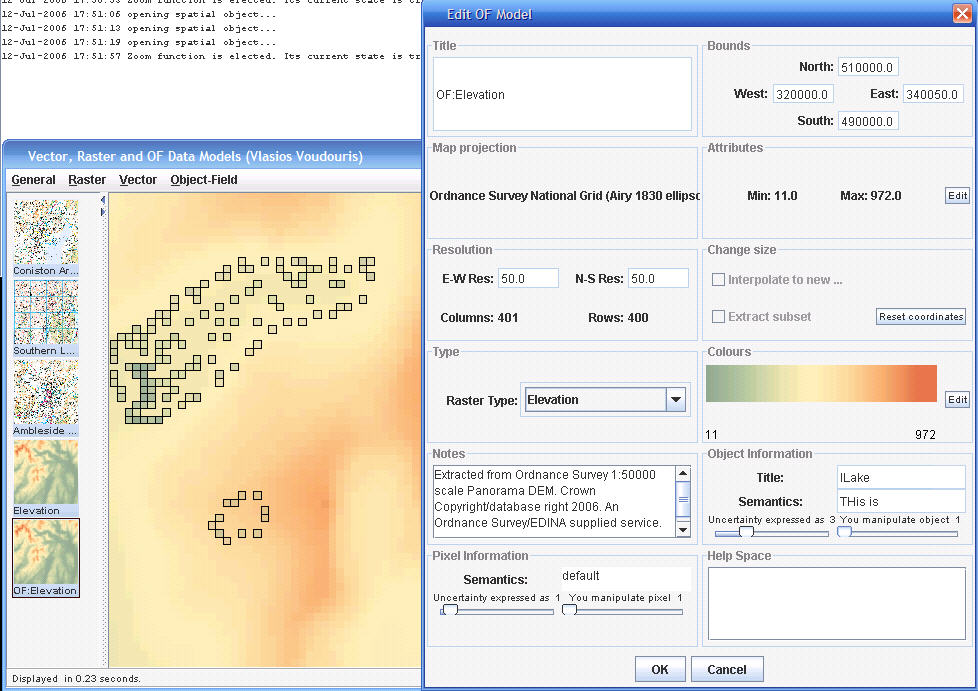
This is the poster I presented at GIScience 2006. The poster forms part of a proposal to consider how the Object-Field model, a model that is considered to combine both the discrete-object and continuous-field views, has some unique qualities for collaborative decision making. It aims to prompt conceptual and theoretical thoughts and discussions by identifying when to use the Object-Field model and not the conventional object and field models . The insights and comments addressed the following kinds of questions :

1) Is the integration of knowledge and observational data useful & usable ?

2) Is the integration of Object & Field views brings new analytical advantages?

3) Is the Object-Field model an improved sharing of collaborative analysis means?
An answer?
The Object-Field model enables visualization and representation of objects in a field. This approach (visualization of field objects) could work better than the conventional approaches in a collaborative environment by presenting the users with multimedia objects, objects that record information in text, image or other forms, related to specific locations or a set of locations in a field. An object in this context is a modeller’s conceptualization/knowledge. Thus, the users are not presented with just observational data but this data is augmented by visualized users' conceptualizations/knowledge of geographic domains, and their understanding using embedded metadata expressed as semantic and uncertainty objects. These embedded semantics and uncertainties propose a new dimension in the metadata discussion. This is the explicit recording of collaborative understanding, interpretation and criticism.

In the Object-Field model, the four types of relationships between locations and objects enables the conventional one location-one object and many locations-one object relationship but it also enables the one locations-many objects and many locations-many objects. This mathematically-based relations between objects and locations enables the user to rearrange the objects in a way that supports comparisons. It also enables a object-based approach when operations are applied. Thus different conceptualizations and interpretations between collaborators can be easily visualized and cross-checked by reapplying them to new purposes or procedures

Integrating observational data and derived knowledge (expressed as metadata objects in the Object-Field model) enable us to improve sharing of analysis by designing a user interface that uses the same set of tools for the exploration of data and knowledge. This integration is important in cross-cultural collaborative environments as it manages semantic inaccuracies and making metadata not only useful but also usable.

Definitions of Object-Field, Field and Object


The Object-Field view of the world is considered to combine of both the discrete-object and continuous-field representations. The Object-Field model attempts to integrate the field and the object view in a single, combined and integrated data model. This is achieved by mapping locations in a field to objects. Aggregating field locations forms the objects. ). This model uses a single elementary spatial unit (hereafter object element) to exploit the benefits of continuous-field and discrete-object views. The object elements are associated with a field value and a variable number of object references. See an Object-Field example by Cova & Goodchild (checked 14 October 2006).

the discrete-object view of the world is considered as a series of entities located in space. An object is a digital representation of these entities. Objects are classified into different object types such as point objects (stores), line objects(retail network) and area objects (London Boroughs). These Objects are defined by their boundaries. In turn, we attach/associate one or more attributes with these objects to specify what is located at these places. These general classes are instantiated by specific objects and, we can attach behaviours to these objects

The continuous-field view of the world is made up of properties varying continuously across space. The key factors of the field view are spatial continuity and self-definition. As the key characteristics of the field view is spatial continuity and self-definition we are not forced to identify objects and their boundaries. In other words, the field is a collection of a certain kind of measurements (such as consumer’s spending behaviour) that are used to define a value everywhere in the field and it is the values themselves that define that field.

My publications about the Object-Field Model, collaborative Visualization and Decision Making

Voudouris, V., P. F. Fisher and J. Wood (2006) 'When and Why Object-Fields and not just Objects or just Fields?'. Presented at the Fourth International Conference on GI Science 2006 (Germany), Ifgi-Prints Series.

Voudouris, V., P.F. Fisher and J. Wood (2006) 'Capturing Conceptualization Uncertainty Interactively using Object-Fields' in W. Kainz, A. Reid and G. Elmes (eds) 12th International Symposium on Spatial Data Handling. Springer-Verlag.

Voudouris, V. P.F. Fisher and J. Wood (2006) 'Collaborative Visualization: Metadata within Object-Fields as Communication Means'. Presented at the RGS-IBG Annual International Conference 2006, London, UK.

Voudouris, V. and S. Marsh (2006) 'Geovisualization and GIS: A Human Centred Approach'. In Visual Languages for Interactive Computing: Definitions and Formalizations (Eds, F.Ferri), Idea Group Inc.

Voudouris, V., J. Wood and P.F. Fisher (2005) 'Collaborative geoVisualization: Object-Field Representations with Semantic and Uncertainty Information' in: Meersman, R., Tari, Z., Herrero, P., et al (Eds) On the Move to Meaningful Internet Systems OTM 2005, Lecture Notes in Computer Science (LNCS), Vol 3762, Springer, Berlin

Friday, October 13, 2006

Welcome


The purpose of this blog is to promote discussions about the Object-Field model, applied statistics and mathematics, decision making, visualization, object-oriented modeling and knowledge representation.

From time to time, I will post my personal opinion about these issues based on my research and work experience.

Please post interesting ideas, links and articles about the data and knowledge modelling, applied statistics and mathematics, theory of decision making, visualization and object-oriented modeling.